Choosing between daily fantasy sports and sports betting is more than just picking a game. It’s about the mindset you adopt. One path lets you be an architect, the other a critic. This is the core difference.
In DFS, you’re a builder. You have a salary cap and a puzzle to solve. Your goal is to find the most value, not just the best players. It’s about making the most of your budget.
In sports betting, you’re a critic. You’re not building a team; you’re judging the odds. A point spread is a story, and you’re trying to see through it. Prop bets are bets on specific player performances. It’s about analyzing the market.
This isn’t about which is better. It’s about your approach. Are you a builder of rosters or a critic of odds? This choice is fundamental. It’s about creating or deconstructing a narrative. For those who love DFS lineup construction, the puzzle is everything.
Let’s explore these differences: the salary cap’s elegance versus the narrative world of lines and props.
Correlation Stacks vs. Anti-Correlation
In fantasy sports and sports betting, two groups are always at odds. One side goes for a big win, the other spreads out their bets. Knowing this difference can mean the difference between winning and losing.
The DFS way is to bet on a team’s whole offense. You pair a quarterback with his top receiver and maybe a tight end. When they score, everyone in your lineup does too. It’s a bet on a specific game outcome.
This strategy is based on simple math. Research on DFS strategy shows it works. In big tournaments, this is often the only way to win.

On the other side, there’s anti-correlation. In betting, betting on one team means you’re against the other. You can’t win on both sides of the same bet.
This idea also applies to DFS. When everyone bets on one team, smart players bet on the other. They look for the less popular quarterback or receiver. This is like betting against the favorite in sports betting.
The table below shows the main difference between these strategies:
| Strategy | Core Philosophy | Primary Arena | Risk Profile |
|---|---|---|---|
| Correlation Stack | Concentrated upside, narrative betting | DFS Tournaments (GPPs) | High variance, boom/bust |
| Anti-Correlation/Fade | Diversified exposure, contrarian positioning | Sports Betting & DFS pivots | Lower correlation, unique paths |
| Ownership Pivot | Game theory against the field | Large-field DFS contests | Moderate variance with differentiation |
So, when do you use each strategy? The correlation stack is for DFS tournaments. It’s when you’re sure about a game’s outcome. You’re betting on a specific story.
The anti-correlation fade is for betting and DFS. It’s about betting against the popular choice. When everyone bets on one team, bet on the other. This offers similar chances but with less competition.
These contest differences change how you play. DFS players look for big wins. Betting players bet against the favorite. But the best players use both ideas. They find DFS opportunities in betting markets and vice versa.
As shown in format differences, it’s not about choosing one over the other. It’s about knowing the game you’re playing. In DFS, go for correlation. In betting, bet against it. The smart player knows when to do both.
The key is that these strategies can work together. The best DFS lineups have both a main stack and anti-correlation plays. It’s like having a main bet and a hedge at the same time. Welcome to modern game theory, where you can bet on and against the tide at the same time.
Late Swap vs. Fixed Cards
Imagine playing chess where you can move your pieces after your opponent has already taken their turn. Now imagine playing chess where the board is glued shut. Welcome to the central, temporal rift that defines these contest differences.
Daily Fantasy Sports, with its late swap feature, is a living document. Your lineup strategy isn’t set in stone at lock; it’s written in pencil, with a big eraser handy. If a star player gets a surprise “DNP – Coach’s Decision” five minutes before tip-off, you lose in the glued-shut chess game. But in DFS, you can scramble and sub in a value play from the late game, turning panic into a possible edge.
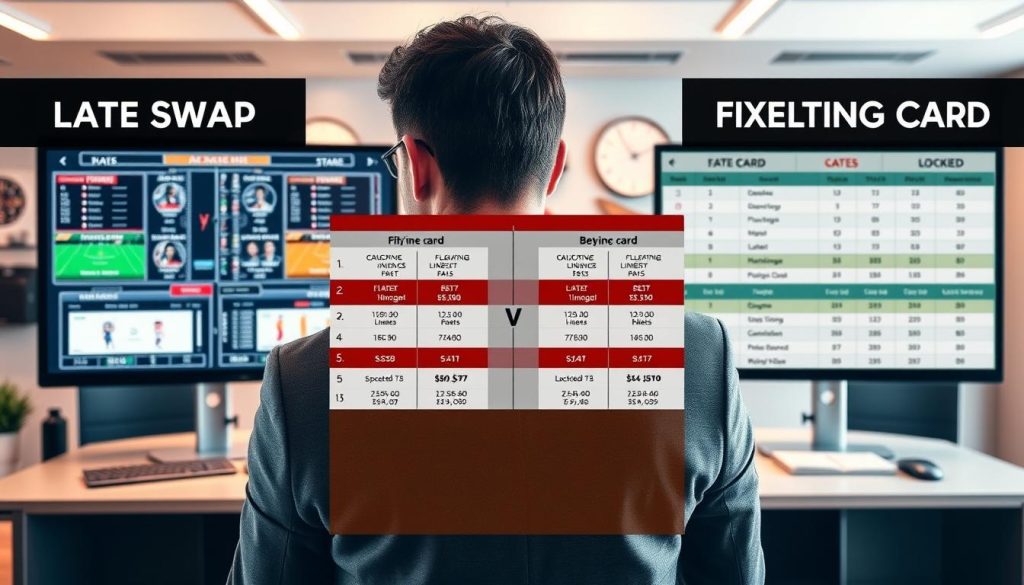
This contest rewards vigilance and punishes complacency. It’s like trying to frantically rewrite your thesis while the professor is already red-penning the first page. Success depends on a deep bench of news alerts, backup plans, and the willingness to pivot at a moment’s notice. The game isn’t just who you pick, but how you manage the chaos after the picks are made.
Your betting slip, by stark contrast, is a fossil the moment you submit it. It’s a fixed card, a set of promises locked in amber. There is no swapping out a losing leg of a parlay when the running back tweaks a hammy in warmups. The thrill—and the terror—is in that finality. You are a sculptor who has thrown their clay in the kiln. Now you just wait to see if it cracks.
This fundamental difference—malleability versus permanence—dictates your entire mental framework. The DFS player’s mind is a war room, screens glowing with real-time data, always ready to execute a contingency plan. The sports bettor’s mind is that of a juror; they must reach absolute conviction before the verdict is locked in. There is no appeals process.
So, which environment suits you? Do you thrive in the controlled chaos, where a last-minute injury report can be an opportunity to outmaneuver a sleeping field? Or do you prefer the cold, sober finality of a decision made, a wager placed, leaving you with nothing to do but watch and hope? Your answer reveals more about your temperament than any bankroll statement ever could. One lineup strategy is a continuous negotiation with reality. The other is a signature on a dotted line.
These contest differences create entirely separate skill sets. Mastering one doesn’t guarantee success in the other. It’s the difference between being a battlefield medic and a forensic pathologist. Both deal with outcomes, but one is reacting to events as they unfold, while the other analyzes the immutable facts of what already transpired.
Bankroll and Variance Profiles
In DFS and sports betting tournaments, your bankroll is key. Variance can change a sure win into a loss. It’s not just about picking winners; it’s about managing your funds through luck and skill.
Think of your bankroll as a financial portfolio. You wouldn’t put all your money in one stock. Your bankroll is your strategic capital. How you use it in DFS vs. betting tournament contests is critical.
Every winning strategy starts with a simple truth: contests vary. Your lineup strategy and bankroll strategy are linked. In DFS, cash games offer steady, low-variance returns. GPP tournaments are high-risk, high-reward.
Your bankroll management should match this. A solid staking plan is essential. Risk only a small percentage of your bankroll on any contest. The 1-3% rule is a common, conservative approach.
This rule means if you have $1,000, bet $10-$30 on a contest. It’s not just about keeping money; it’s about surviving losing streaks. You want to be a casino, not a lottery player.
Let’s look at variance profiles of different contests:
| Contest Type | Variance | Bankroll Allocation | Risk Profile |
|---|---|---|---|
| Cash Games (50/50s, Double-Ups) | Low | Core Holding (60-80%) | Capital Preservation |
| Single-Entry Tournaments | Medium-High | Speculative (15-25%) | Balanced Growth |
| Multi-Entry GPPs | Extremely High | Speculative (5-10%) | High-Risk, High-Reward |
| Sports Betting (Single Wager) | High | Variable | High Risk |
| Sports Betting (Parlay) | Extremely High | Minimal (1-2%) | Extreme Risk |
The higher the payout, the smaller your stake should be. High-variance plays like GPPs are like lottery tickets. Betting too much on them can lead to bankruptcy. A smart bettor might bet 90% on low-to-mid variance plays and 10% on high-risk bets.
Understanding the sports betting glossary is key. Knowing the difference between prop bets and futures bets affects your risk. Variance is a natural force you must navigate. The goal is to understand and manage it, not eliminate it.
So, are you a day trader or a long-term investor? Your bankroll strategy is what separates a smart player from a gambler. It’s the difference between a full wallet and an empty one.
Cross-Training Drills
Imagine you’re a financial analyst who works with both forex and commodities. Even though the charts look different, the basic risk principles are the same. This is similar to learning the contest differences between DFS and sports betting. You’re not just learning two games; you’re building a single analytical skill for both.
Your first drill is translation. Take your DFS research and apply it to prop bets. For example, your deep dive into a tight end’s red-zone targets can help with a prop bet. Research on a running back’s efficiency against a specific defense is useful for both DFS and betting on his rushing yards prop. The goal is to find mismatches and use them to your advantage.
Next, practice creating betting narratives. If you see a game as a defensive, run-heavy game, bet on the Under. This also tells you to avoid high-priced, pass-catching running backs in DFS. The same thinking applies to both contests.
Lastly, use betting markets to inform your DFS strategy. When sharp money bets on a point spread or total, it’s a signal. If the Under is favored, it might mean the public is wrong. In DFS, this could mean targeting defenses or running backs in low-scoring games. This approach combines the regulatory and structural nuances of both formats for a competitive edge. The contest differences between DFS and betting tournaments are big, but a sharp mind can use one to inform the other.