Most players look at a tournament payout sheet like a menu. They focus on the big number at the top. I see it as a map, showing the journey from the min-cash to the top prize.
Is the path to victory a gentle slope or a steep cliff? Modern tournament structures have two worlds. One is ruled by ICM, where every spot matters. The other is a bounty system, driven by chips.
Knowing this split is key to mastering the game. It’s where the idea of “equity drop” comes in. This concept changes how you play, making calls more profitable with bounties. It’s all about adjusting your risk based on the prize pool, as seen in detailed payout analyses. Chips aren’t always worth the same as cash. That’s where the real ICM magic happens.
ICM for Betting Contests (Intuitive Approach)
Forget complex formulas; understanding ICM for betting contests is like realizing the Monopoly board isn’t flat. Some properties cost you more than just cash. In a cash game, the universe is simple. A chip equals a dollar. Your risk is linear, and your reward is direct. Enter a tournament, and the physics change. Suddenly, you’re playing in a curved space where gravity increases as you near the money.
The Independent Chip Model is that gravity. It’s not some abstract math problem. It’s the very real force that warps a chip’s dollar value based on your stack, everyone else’s stacks, and the prize pool’s shape. ICM converts chips to dollars by estimating your probability of finishing in each paying spot. Your strategy, therefor, shifts from maximizing chips to maximizing dollars. This is the core intuitive leap.

This creates a fascinating trade-off: the “Risk Premium.” Think of it as the tournament’s survival tax. In a cash game, if you have a 60% chance to win a pot, you call. It’s pure math. In a tournament, with ICM pressure, you might need a 70% or 80% chance to make the same call profitable. Why? Because a loss hurts your tournament equity far more than an equivalent gain helps it. Busting on the bubble is a financial catastrophe. Doubling up early doesn’t double your cash value.
My intuitive approach? Treat every all-in decision as a bet on your entire tournament life, not just the hand. ICM is the internal caddy whispering, “You really want to go for that green over water with a 7-iron?” This risk premium directly measures the survival pressure you feel in a Multi-Table Tournament. It’s the price of admission to the money.
To see this in action, let’s break down how chip valuation changes under ICM versus a cash game environment.
| Aspect | Cash Game | Tournament (ICM Environment) |
|---|---|---|
| Chip Value | Static. One chip = one dollar. | Dynamic. Value depends on stack sizes and proximity to payouts. |
| Risk Premium | None. Decisions are based purely on pot odds. | High. Requires extra equity to compensate for tournament bust-out cost. |
| Primary Goal | Maximize chip count (dollars). | Maximize dollar equity, which may mean folding strong hands. |
| Impact of Busting | Lose your buy-in. Rebuy and continue. | Lose all future prize pool equity. Game over. |
| Equity Calculation | Immediate pot odds. | Future prize pool odds, weighted by finish probabilities. |
See the difference? The cash game column is all about immediate, tangible value. The tournament column is a speculative future asset. Your chips are stock options in your own performance. When you grasp this, your play tightens up near the money. You start passing on small edges. You become a portfolio manager, not a gambler.
This intuitive view of ICM transforms how you see betting contests. It’s the framework that explains why nitty play on the bubble is often correct, even if it feels weak. For a deeper dive into the mechanics, check out our guide on the fundamentals of ICM. Remember, in a tournament, you’re not just playing cards. You’re navigating a live economic simulation where every chip is a tiny, gravity-warped planet of possible cash.
Risk Adjustment by Stage and Position
ICM’s effect isn’t just a yes or no. It’s more like a dimmer switch that starts to change things early on. Most players just keep playing the same way, not thinking about the big picture. But the smart ones are already planning ahead, knowing the prize pool’s pull is strong.
Studies show the real impact of ICM starts when 50% to 37% of players are left. That’s when the game changes, even if it feels like just a few players are left. The bubble is far away, but the game has already shifted.
This change affects how you play. You play tighter, fold more, and think about the big picture. Even with a lot of chips, every decision is about the future prize pool, not just the hand. This makes every call riskier.
Big blinds are the toughest spot. As the game goes on, defending your big blind becomes more about the prize pool than the hand. Antes make it even tougher. Folding can be a superpower.
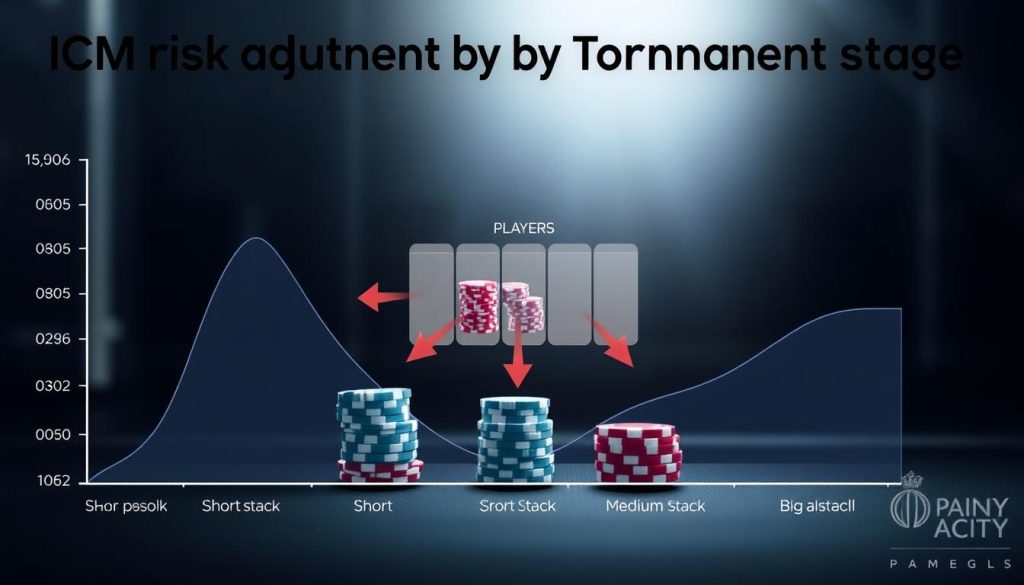
Your seat at the table is like a lifeboat on the Titanic. Position is key, not just for info. A short stack in early position is in trouble. A big stack in late position has a lot of power. The smart player uses position to put pressure on others.
Your strategy must change. You start aggressive, then focus on survival. The goal is to have the best chance of winning, not just to have the most chips. You pick your spots carefully, folding hands that would be called in cash games. The prize pool is your main opponent now.
| Stage (% Field Remaining) | ICM Pressure Level | Key Strategic Mandate | Rationale |
|---|---|---|---|
| Early (100% – 70%) | Negligible | Accumulate Chips Aggressively | Chip value closely approximates cash value. Build a foundation. |
| Mid (50% – 37%) | Significant | Tighten Defense, Especialy from Blinds | Folding preserves equity. Calling risks a disproportionate loss of future prize pool share. |
| Late (Bubble & In The Money) | Extreme | Survival & Laddering | Each step up the payout curve represents a geometric win for your bankroll. Minimize coin flips. |
This table is more than theory. It’s a guide to survival. The mid-stage, from 50% to 37%, is critical. The real game starts here, long before payouts. Adjusting to the prize pool curve is what separates the pros from the amateurs.
Examples: Flat vs. Top-Heavy
Imagine you’re a poker player facing two tournaments with the same prize pool but different rewards. One is like a skyscraper, where the top is everything. The other is like a suburb, where every home has a nice yard. Your goal is to pick the right path for the terrain.
A top-heavy payout structure is like a lottery. The winner gets a huge sum. The pay jumps are so high, they might make you dizzy. Making it to the money is just the start.
You’re not just playing to survive. You’re playing to win big.
This environment needs a bold, aggressive style from the start. Calling a shove with a weak hand is a big risk. Your strategy shows that most of the value is at the top.
On the other hand, a flat payout structure spreads the wealth evenly. It’s like climbing a steady corporate ladder, not a steep cliff. Each step up brings a meaningful pay bump.
In this world, survival is key. Making the money is just the start of a careful grind. Early on, it’s better to play safe than to risk everything for a small edge.
To see the difference, let’s look at numbers. Below is a comparison for a 100-player tournament with a $10,000 prize pool, paying the top 15.
| Place | Top-Heavy Payout (%) | Flat Payout (%) |
|---|---|---|
| 1st | 30% ($3,000) | 18% ($1,800) |
| 2nd | 20% ($2,000) | 15% ($1,500) |
| 3rd | 12% ($1,200) | 12% ($1,200) |
| 4th | 8% ($800) | 10% ($1,000) |
| 5th | 6% ($600) | 9% ($900) |
| 6th-10th | ~3% avg ($300) | ~6% avg ($600) |
| 11th-15th | ~1.5% avg ($150) | ~4% avg ($400) |
The top-heavy model is like a predator, giving a lot to the top and little to others. The flat model is like a community garden, where everyone gets a fair share.
This isn’t just math. It’s a test of your strategy. In a top-heavy game, folding in 10th place is a failure. But in a flat game, moving up from 15th to 10th can double your money. This shows the value of patient play.
So, before you play, read the payout sheet carefully. Is it a steep curve for glory or a gentle slope for steady rewards? Your strategy must adapt to this, changing from early steals to final table shoves.
Bankroll Implications
Forget the chips in front of you. Your bankroll is the only currency that matters. It’s your portfolio, your war chest, your final grade on the poker report card.
Flat-structure tournaments demand a bond trader’s patience. Your growth comes from applying relentless ICM pressure. The variance is low. Your equity curve should look like a calm lake, not a heart monitor.
Top-heavy majors are a different beast. This is high-stakes venture capital. You’re buying skilled lottery tickets. The swings can feel like a rollercoaster designed by a sadist. One score is glorious. A string of bubbles is soul-crushing.
Now, toss in bounty PKOs. Every knockout is a cash register ring. This creates wild, mid-hand risk adjustments. Do you have the bankroll—and the nerves—for that kind of volatility?
The truth is simple. Your roll chooses your game. A short stack playing top-heavy bounties is a financial suicide note. Sustainable wealth isn’t built on heroic calls. It’s built on cold, calculated table selection.
This is the grand calculus. You move from analyzing a single hand to managing your entire poker career. That’s how you turn a hobby into a business. Your bankroll isn’t just a number. It’s your strategy.