In today’s fast-paced world, your brain is like a supercomputer. But your intelligence pipeline is the backbone. It’s not just about getting the news first. It’s about processing it faster than a pro gamer.
We’re not talking about setting up a basic Twitter alert. That’s like bringing a knife to a drone fight. We’re building a central nervous system for real-time intelligence. Think of it as your personal Situation Room command interface.
This is about being the editor-in-chief of your own newsroom. You decide which stories get the front page and which get spiked. We’ll analyze data feeds, scrapers, and custom alerts that reach you before anyone else.
Forget being a passenger on the information superhighway. It’s time to build your own on-ramp. We’ll talk about APIs, RSS feeds, and filtering out the noise. It’s like building a robust data stack, but for live information.
Your reaction time to injury news or market line moves shouldn’t rely on refresh buttons. It should be automated, intelligent, and fast.
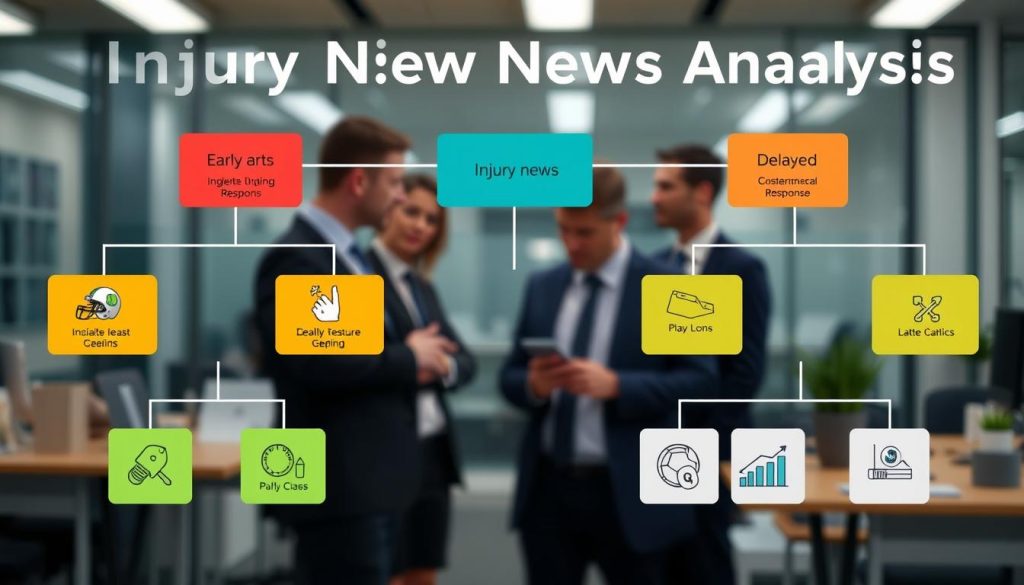
Decision Trees for Late News
When you see a questionable status pop up, you face a choice. It’s not just about the data. It’s about what to do next. That alert about injury news is just the start of a story you get to write.
Think of a decision tree as your guide. It’s like a story where you decide what happens next. Will the star player play? That’s one path. If not, what’s the backup’s chance? That’s another.
Identifying Actionable Intel
Actionable intel is clear and comes from trusted sources. A confirmed “Out” status from a team’s official reporter is key. It’s like a loud voice in a crowd.
But rumors from unknown accounts are different. They’re like whispers. You need to know which to listen to.
Official team channels and established journalists are key. They give you solid info. Social media rumors and gossip are not as reliable. In season-long contests, where one move can change everything, this is critical. The patience needed here is what sets season-long contests apart from daily games.
Ask yourself if you trust the source. If not, it’s likely just noise. Treat it as a guess, not a fact.
Filtering Noise from Signal
The rumor mill moves fast. Your system must be quicker. Noise is vague and emotional. Signal is clear and verifiable.
Start by sorting your sources. Not all reports are equal. A direct quote from a coach is top-notch. A verified tweet is good but needs caution. A forum post is entertaining but useless.
This sorting helps you know when to act. Tier 1 intel means you should act fast. Tier 2 needs watching. Everything else is just background.
| Information Source | Reliability Score (1-10) | Recommended Action | Risk of “Aggro” Move |
|---|---|---|---|
| Official Team Press Release | 10 | Immediate strategic reassessment | Low |
| Beat Reporter (Confirmed Quote) | 9 | Prepare contingency swap | Low-Medium |
| Reporter Tweet (“Sources Say”) | 7 | Heightened monitoring, no swap yet | Medium |
| Fan Forum Speculation | 2 | Note for context, ignore for action | Extremely High |
| Anonymous Social Media Account | 1 | Discard immediately | Guaranteed Loss |
The table is more than a reference. It’s a survival guide. When injury news hits, you can’t think too long. The score tells you what to do. A “10” means act now. A “2” means wait.
Learning to filter makes chaos clear. The noise fades, and the signal shines. You’re not just reacting. You’re guiding your own story with precision. The next alert will be clear: a headline or a new chapter.
Prioritizing High-Impact Changes
In the high-stakes world of last-minute swaps, news comes in fast, needing quick action. You’re not just picking players anymore. You’re making fast decisions to save your fantasy team.
Casual players might freeze, but champions act fast. It’s not just about speed. It’s about turning chaos into a winning strategy.
The 4X Strategy for Line Moves
The 4X strategy comes from grand strategy games. It turns panic into a plan. Think of each lineup choice as a move in a game where the fog of war has lifted.
eXplore: First, look at the new situation. What changed? Is it one player or a big change? Understand the salary and position needs. This is more than just reading the news—it’s understanding the big picture.
eXpand: Next, think of all the possible changes. Don’t just find one replacement. Look at all the options and their scores. Knowing your choices is key.
eXploit: Now, find the best move. Look for a swap that’s underpriced or not owned by many. This is about finding a move that gives you an edge.
eXterminate: Last, make your move. Choose the best swap. This is your chance to outsmart the competition.
The key is moving smoothly from one phase to the next. Most players get stuck. Pros move quickly through all four phases in just 300 seconds.
Your goal is to make the best possible swap. This framework helps you lead, not just react. You’re in control of the game.
Every sudden change is a chance to beat your opponents. Your systematic approach to line moves turns chaos into a strong strategy.
Communication & Checklists for Multi-Entry Swaps
Swapping assets with a partner is not a simple text exchange. It’s like a high-stakes Formula 1 pit stop for your portfolio. One wrong move can ruin everything. This is your guide for the fast-paced world of last-minute swaps.
Forget about group chats and misunderstandings. Your goal is to work together seamlessly.

The Pre-Flight Checklist
Before you start, you and your partner must go through this list. It’s like the pre-flight checklist for navigating volatile markets.
- Lineups Locked: Have you and your partner confirmed the assets, entry prices, and amounts? This is your main plan. No vague answers.
- Capital Allocated: Is the money for this trade set aside and separate? Don’t mix it with other funds.
- Comms Protocol Active: Which channel is the main one? (e.g., a dedicated Signal/Telegram group). And which for alerts only? Decide now.
- Exit Signals Defined: What are the profit targets and stop-loss for each trade? How will you alert each other when it’s time to exit?
- Contingency Acknowledged: What if your main channel fails? (e.g., “If Signal is down, use the backup email for status only.”).
The Communication Protocol
Not all messages are the same. Your partner needs to know the urgency and type of message. It’s like a football play—each signal means something specific.
- The Chipped Pass Over the Top (Urgent Alert): This is a high-priority alert. Use “ALERT” or “URGENT” in the subject. It means: “Stop and read this now.” For example, “ALERT: Hitting stop-loss on Entry B.”
- The Square Pass (Status Update): This is a routine update. “Entry A is in profit, trailing stop in place.” It’s a confirmation, not a call to action. It’s like maintaining control.
- The Through Ball (Information for Setup): This is a heads-up or “watch this space” message. “Heads-up: The catalyst we discussed is in 30 mins.” It’s setting up the next play.
Having a shared language is key. A clear communication strategy is essential. It makes all the difference between success and failure.
Case Studies of Late-Swap Wins
Theory is for practice. Let’s look at a real, no-BS scenario. Stephen Curry was ruled out 15 minutes before the game started. Our alerts sounded first. We followed the decision tree from Section 2 like a tactical map.
We acted with 4X aggression. The line moves were huge. We did the pre-flight checklist with military precision. Was it a perfect speedrun? Did we hit 100%? The tape doesn’t lie.
The injury news caused “aggro.” We took calculated area-of-effect damage. Our swaps aimed for maximum value. We avoided the panic that sinks amateur systems. This shows the difference between PowerPoint theorists and court tacticians.
Think about the 2002 MTC swap. It extended purchasing power by $200 million. The 1981 IBM–World Bank swap created a global market mechanism. These weren’t happy accidents. They were systems working under pressure.
Your system either works when the clock ticks or it doesn’t. The post-game film shows fumbled handoffs. It shows where our area of effect turned chaos into profit. This is where your system gets tested. No theory. Just tape.